

UK Trains and Buses With Pets: Travel Guide
Short Answer
Most UK train and bus operators set their own current pet rules, so check before every journey. Use a secure carrier where appropriate, travel at quieter times, practise station and vehicle sounds gradually, and keep identification, water and cleaning supplies accessible.
Dogs on UK Trains: The General Rules
The good news for dog owners is that most UK train operators welcome dogs on board. The standard position across the National Rail network is that up to two dogs may travel with each passenger, free of charge, as long as they are kept under control and do not take up a seat.
However, there are some important details to be aware of:
"Under control" is interpreted broadly. Your dog does not need to be on a lead at all times in every situation, but they should not be causing distress to other passengers, jumping on seats, or wandering through carriages unsupervised. In practice, keeping your dog on a lead for the duration of the journey is the sensible approach and the one most operators will expect.
Dogs are not permitted on seats. If your dog takes up a seat and other passengers need it, you will be expected to move them. This is a courtesy rule as much as a formal one, but it is worth knowing.
Some routes and operators have additional rules. Transport for London (TfL), which operates the Underground, Overground, Elizabeth line, and DLR, generally permits dogs on all services, but dogs must be carried or kept on a lead. On the London Underground, dogs are not permitted on escalators and must be carried on them. Small dogs and cats in carriers travel free on TfL services.
Cross-border and long-distance trains may have specific policies. Operators such as Avanti West Coast, LNER, CrossCountry, and TransPennine Express each have their own pet policies, which are available on their websites. It is worth checking directly with your operator before travelling, particularly for longer journeys where the logistics of managing a dog for an extended period are more significant.
Cats and Small Pets on Trains
Cats travelling on UK trains should be in a secure, well-ventilated carrier. Most train operators that permit dogs will also permit cats and other small pets when contained in an appropriate carrier, though they may have specific rules about the size of carrier permitted or whether the carrier can occupy a seat.
The key principle is containment. A cat in a secure carrier is unlikely to cause concern for other passengers or staff. A cat on a lead or partially secured is a different matter, and most operators would not consider this appropriate.
For cats particularly, the carrier you choose makes a significant difference to how settled they are during the journey. A carrier that is too large may cause your cat to feel unsecured and anxious. One that is too small, poorly ventilated, or unfamiliar will also cause stress. Introducing your cat to their carrier at home well in advance of any journey is strongly recommended.
Dogs and Cats on UK Buses
Bus policies on pets are more variable than train policies and are significantly less standardised across the UK. The key points to understand:
Most bus operators permit small dogs and cats in carriers. A cat or small dog in an enclosed carrier is generally treated similarly to any other small item of luggage and is typically permitted without issue.
Larger dogs are at the discretion of the driver. Many bus operators allow well-behaved dogs on buses, but the driver has authority to refuse entry if they consider the dog a risk to passenger safety or comfort. A large, excitable, or poorly controlled dog is far more likely to be turned away than a calm, lead-controlled dog sitting quietly by your feet.
Local authority-run bus services and private operators may have their own policies that differ from national operators. Transport for London buses, for example, permit dogs on board at the driver's discretion. Dogs should be kept on a lead and should not occupy seats.
Guide dogs and assistance dogs are legally entitled to travel on all public transport in the UK and cannot be refused entry. This applies to all registered assistance dogs regardless of size or breed.
If you are unsure about the policy of a specific bus service, contacting the operator ahead of time will save you from an awkward situation at the bus stop.
Preparing Your Pet for Public Transport
The rules are one thing. The practicalities of actually travelling with a pet on a busy train or bus are another. The difference between a straightforward journey and a difficult one comes down largely to preparation.
Familiarise Your Pet With Carriers and Enclosed Spaces
For cats especially, the carrier should feel like a familiar, safe space rather than something that only appears before stressful events. Leaving the carrier out at home with bedding inside, allowing your cat to enter and exit freely, and feeding occasional meals inside it all help build a positive association.
For dogs, similar principles apply. A dog that is comfortable in a crate or enclosed space at home will transfer that comfort more readily to a carrier on a train. Our article on building a positive association with a crate for your dog covers the gradual introduction process in detail, and the same approach applies when preparing a dog for any new enclosed space.
Choose the Right Travel Equipment
The carrier or containment option you use affects not just your pet's comfort but also your experience as a passenger, and how other travellers perceive you.
For smaller dogs and cats, a well-structured carrier that sits on your lap or on the floor provides security for your pet and keeps them contained without taking up excessive space. For dogs too large for a lap carrier, a lead and calm handling are the practical options on trains and buses.
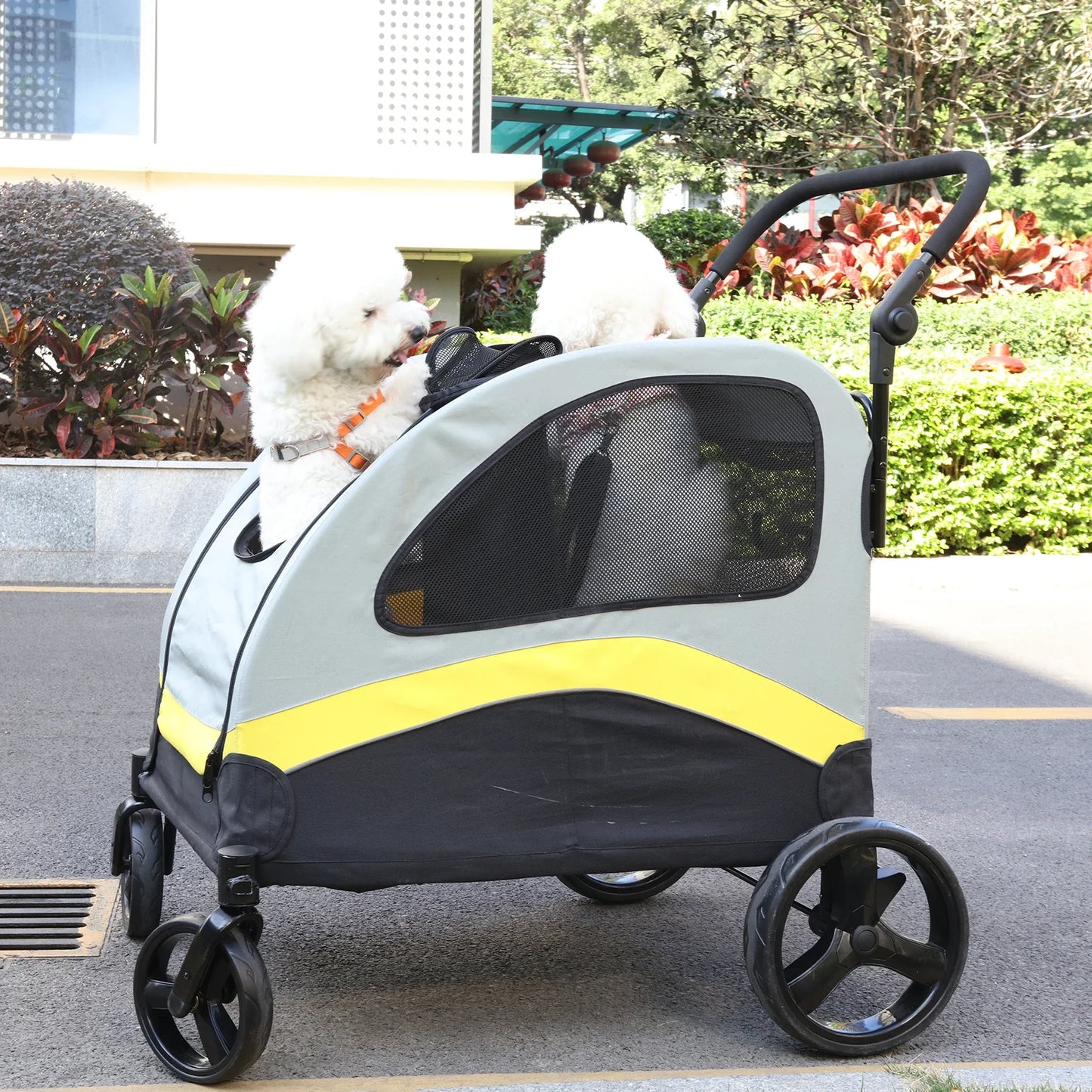
A pet stroller is worth considering for owners who travel frequently with smaller or older pets on public transport. A folding stroller allows your pet to travel in comfort, gives them a familiar, contained space, and folds down easily when boarding or when space is limited. Our one-click folding pet stroller with shock absorbers folds quickly for exactly this kind of situation, and its design suits both dogs and cats. For those travelling with two smaller pets, our double pet stroller with zipper divider provides separate, secure compartments within a single unit.
You can explore our full range of pet strollers and travel carriers to find an option suited to your pet's size and your travel habits.
Time Your Journey Thoughtfully
Travelling during off-peak hours reduces the likelihood of a crowded carriage, which is better for anxious pets and makes it easier to find space near a door or in a less busy area of the train. Early mornings and mid-afternoon on weekdays tend to be quieter than commuter hours.
If your dog or cat is prone to travel anxiety, a shorter first journey in a quiet period is far more useful preparation than a long first journey during a busy commute.
Bring What Your Pet Needs
For longer journeys, think about what your pet will need to remain comfortable. A small amount of water and a portable bowl are worth having for dogs, particularly in warmer weather. A familiar blanket or item of your clothing inside the carrier can help a cat feel settled. Treats used calmly and quietly can reinforce good behaviour during the journey.
Avoid feeding a full meal immediately before travel if your pet is prone to motion sickness. A light stomach generally makes for a more comfortable journey.
Managing Anxiety During the Journey
Some pets take to public transport naturally. Others find the noise, movement, and unfamiliar smells genuinely unsettling. Signs of stress to watch for include excessive panting, vocalising, attempts to escape the carrier, or restlessness that does not settle after the first few minutes.
Our guide on keeping pets calm in stressful situations including travel covers calming approaches that apply equally to travel anxiety, including the role of familiar environments, covering carriers, and timing.
If your dog has significant travel anxiety, it is worth speaking to your vet before committing to public transport as a regular option. There may be short-term calming support that makes the difference.
What About Long-Distance Journeys?
For longer train journeys with a dog, there are a few additional considerations. Longer journeys will likely require your dog to need a toilet stop. Most intercity train stations have open areas outside where dogs can be walked briefly during a connection or longer stop. Planning your route to include a suitable break point is sensible.
Water access is also more important on longer journeys, particularly in warmer months. A portable water bowl kept in a bag is straightforward to carry and worth including as standard.
For owners who also travel by car as part of a multi-modal journey, it is worth having the car element well sorted before you focus on the train or bus leg. Our article on must-have gear for long-distance journeys with dogs covers the car travel side in practical detail, including how to make longer journeys more comfortable for dogs of all sizes and temperaments.
Being a Considerate Fellow Passenger
Public transport is a shared space, and travelling with a pet comes with some responsibility toward other passengers. A few habits make a meaningful difference:
Keep your dog on a lead throughout. Even a calm, well-trained dog should be on a lead in the confined space of a train or bus.
If your dog sheds, bring a small blanket or mat to place on the floor beneath them. This is a small courtesy that other passengers will appreciate.
If your pet begins vocalising persistently, try to settle them calmly and quietly. Persistent noise is genuinely disruptive in an enclosed space, and most operators can ask you to leave if your pet is causing unreasonable disturbance.
Be aware of other passengers' comfort. Not everyone is comfortable around animals, and some people have allergies. Keeping your pet close to you and contained is the right approach.
Frequently Asked Questions
Are pet rules the same on every UK train and bus?
No. Check the current rules for each operator and service, including carrier, lead and assistance-animal arrangements relevant to your journey.
How can I practise before a longer public-transport trip?
Build familiarity with the carrier, station sounds and short journeys gradually. Choose quieter times where possible and keep water and cleaning supplies accessible.